
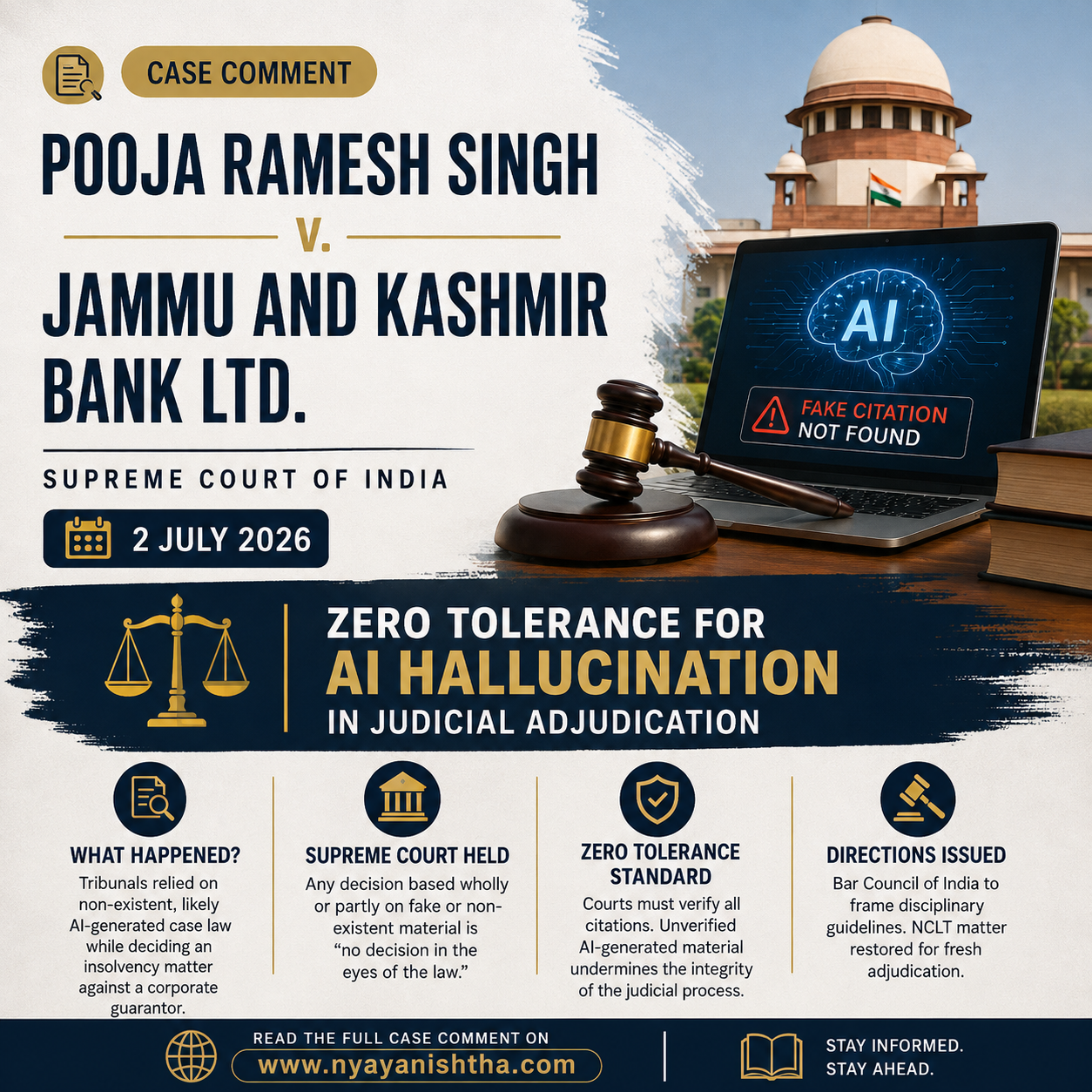
The decision in Pooja Ramesh Singh v. Jammu and Kashmir Bank Ltd., delivered by the Supreme Court, by the bench of Justice P.S. Narasimha and Justice Alok Aradhe, on 2 July 2026, arises out of an appeal against orders of the tribunal under the Insolvency and Bankruptcy Code, 2016, against a corporate guarantor. While the appeal originally concerned whether a corporate guarantee survived an internal corporate restructuring, the Supreme Court did not decide on that. Instead, the appeal became an occasion to confront a far more consequential problem. The tribunal relied on fake and hallucinatory case law generated by Artificial Intelligence tools while passing a judicial order. In doing so, the Court laid down a "zero-tolerance" standard for the use of unverified AI-generated material in courts, making this one of the earliest Indian judicial pronouncements to address AI hallucination as a threat to the dignity and importance of the judicial process.
Pan India Utilities Distribution Company Ltd. (PIUDCL) had taken loans from the Jammu and Kashmir Bank Ltd. A corporate guarantee secured these, Essel Infraprojects Ltd. (EIL). Later, PIUDCL fell into severe financial stress, leading to default on repayments, and its loan accounts became non-performing assets. The appellant, Pooja Ramesh Singh, was a suspended director of EIL. The Bank filed an application under Section 7 of the Insolvency and Bankruptcy Code, 2016, before the National Company Law Tribunal (NCLT), Mumbai, against EIL as a corporate guarantor. The appellant resisted the application on two grounds: EIL has undergone demerger and amalgamation, which transferred its liabilities as a guarantor to other companies, and a 2017 renewal of the sanction letter made no mention of the guarantee, implying its lapse.
The NCLT rejected these contentions and admitted the bank's application, relying on Clause 8 of the guarantee deed, which expressly preserved the guarantee notwithstanding any restructuring of the guarantor.
The appeal filed in the National Company Law Appellate Tribunal (NCLAT), which was dismissed, reaffirms the NCLT's reasoning.
On further appeal to the Supreme Court, counsel for the appellant pointed out that these citations were fake, non-existent, or, most likely, AI-generated. It is pointed out that even where case citations are accurate, the excerpted paragraphs from the judgment are not traceable to those judgments in law reports. The Bank filed an affidavit confirming that its own counsel had never cited these judgments before the NCLT, suggesting that the Tribunal had sourced them independently and that the fabrication had gone undetected through two tiers of adjudication.
The principal issue before the Supreme Court was the legal effect of an order in which the tribunal had relied, even in part, on fake or AI-generated judicial precedents. A secondary, unresolved issue was whether EIL still held the corporate guarantee.
The court held that any decision made wholly or partly based upon fake or non-existent material is "no decision in the eyes of the law." The court held that there should be a "zero tolerance standard" for courts in citing or using AI-generated precedents without verification, and that the judgment must be set aside in its entirety to maintain the integrity of the adjudication and its process. The court said that wisdom and foresight compel us to recognise human vulnerabilities, and if we seek delegation in that work, it will have serious consequences for the core of human existence, which is our capacity to think.
The court directed the Bar Council of India to take up this issue and frame disciplinary guidelines to prevent such occurrences, along with action that will follow a violation of these norms.
The court set aside the NCLT and NCLAT's judgment and restored it to its original number. It said that the NCLT shall proceed with the application in accordance with the law. The Supreme Court did not express an opinion on the corporate guarantee.
The judgment becomes more significant for the institutional intervention on unverified use of AI in adjudication rather than the outcome in the guarantee dispute, which remains undecided.
The court did not completely deny the use of technology; in fact, it said that dependency on technology has never been a problem in dispensing justice, and that the courts have gradually made it an integral part of the system. Still, we need to be extra cautious, as with artificial intelligence, it is not only an aid but also becoming an alternative to our own thinking.
This judgment highlights the common debate that artificial intelligence can have serious consequences in fields that require human thinking and scientific temper. The accountability gap that neither the bar nor the two tribunals could detect the hallucinatory citations exposes a larger vulnerability in the structure rather than a single instance of ignorance. Therefore, by instructing the Bar Council of India to prepare guidelines, the court takes a significant step toward solving this problem rather than treating it as a case-specific issue. The court highlighted an important instance that even the smallest unverified or fake material, regardless of its impact on the outcome, impairs the decision. Here, rather than discussing the relationship between the material and the result, the focus is on the integrity of the process itself.
Pooja Ramesh Singh v. Jammu and Kashmir Bank Ltd. marks an important intervention by the Supreme Court on the use of AI and judicial decision-making processes. Although the primary matter of corporate guarantee is still decided and returns to NCLT for fresh adjudication. The case is significant for its zero-tolerance policy towards unverifiable material regardless of its impact on the decision. The aim is not just to protect natural justice but also the integrity of the system.
Authored by: Ms. Gun Jaiswal
Student, Dr. Ram Manohar Lohiya National Law University (RMLNLU)