
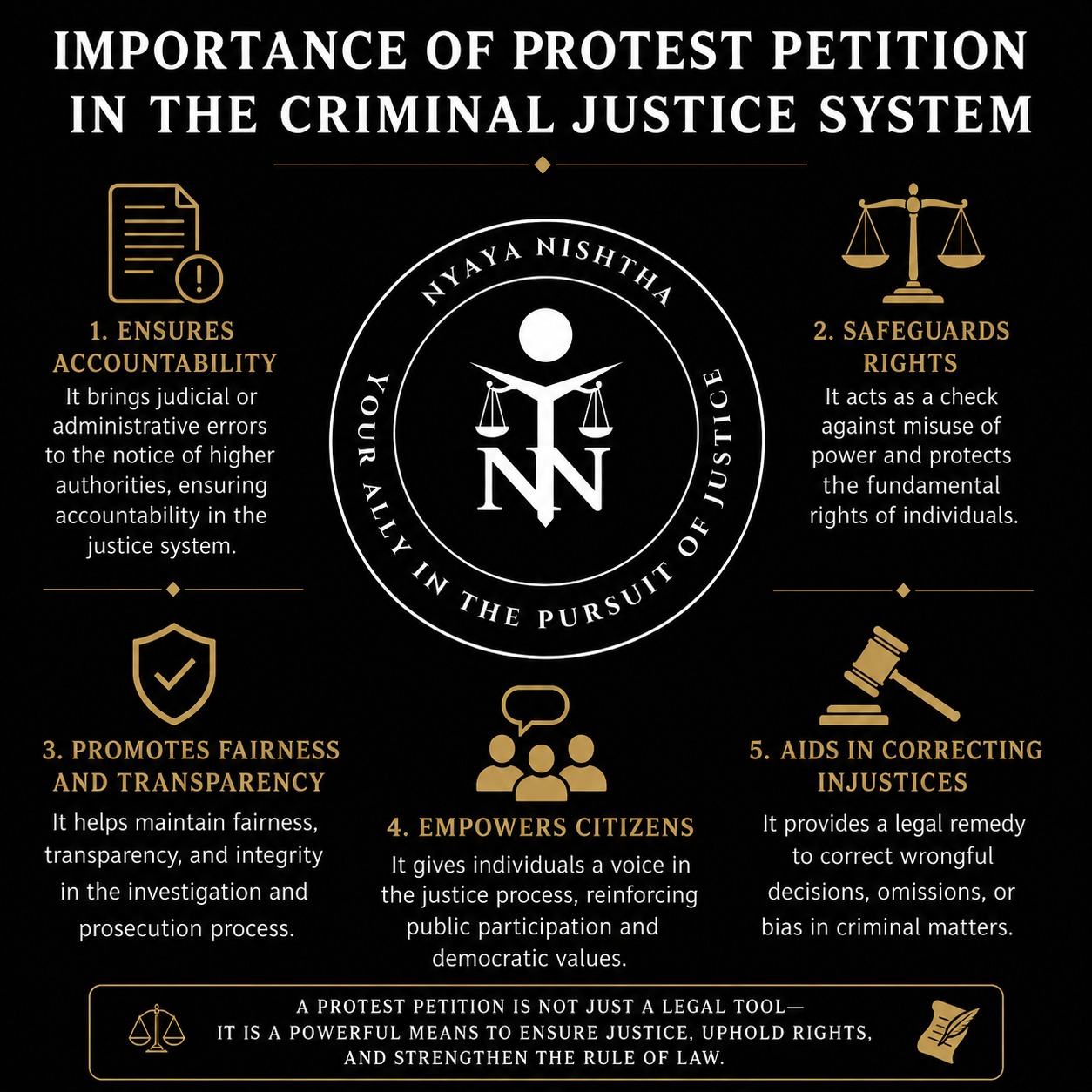
A protest petition is an important legal remedy available to an aggrieved person who is dissatisfied with the police investigation. In other words, when the complainant is not satisfied with the police report, they may file a petition before the concerned court, which is known as a protest petition. Therefore, a protest petition plays a vital role in safeguarding victims' rights and maintaining fairness in India's criminal justice system.
A Protest Petition is not defined anywhere in India’s criminal law system, neither in the Bharatiya Nagarik Suraksha Sanhita, 2023¹ (hereinafter referred to as “the BNSS”) nor in any other penal law. It has developed solely through judicial pronouncements. If either the victim or the complainant files a First Information Report under Section 173 of the BNSS before a police station, the police officer in charge investigates the matter after collecting material evidence. After the investigation, the Investigating Officer may either file a chargesheet or submit a final report in the negative form.
If the Investigating Officer submits the final report in the negative form before the Magistrate, the victim may file a Protest Petition before the Magistrate having jurisdiction. A protest petition is a written request made by a complainant to a Magistrate when they are not satisfied with the police investigation report. It is usually filed when the police say that no crime has been committed, there is insufficient evidence, or no action should be taken against the accused person. Under the BNSS, a protest petition allows the complainant to challenge the police report and ask the Magistrate to order a fresh investigation, reject the closure report, or start legal proceedings against the accused.
Where the Investigating Officer submits a closure report under Section 193(3) of the BNSS, Section 193(3)(iii) mandates that the Investigating Officer shall inform the informant about such action.
As per Vishnu Kumar Tiwari vs The State Of Uttar Pradesh on 9 July, 2019², the Hon’ble Supreme Court observed that when a protest petition is submitted against the final report filed by the police, it is the duty of the learned Magistrate to examine the protest petition. If there is substance in the protest petition, the Magistrate may take cognizance under Section 190(1)(b) of Cr.P.C.
In the case of Pakhando & Others Vs State of U.P. & Another³, the Court opined that in the case of a final report, the Magistrate has four options:
The Protest Petition may be filed before the Magistrate having jurisdiction or before the same Magistrate before whom the Investigating Officer has filed the final report in negative form.
As per Ramakant Singh & Ors. v. State of Jharkhand & Ors. (2023)⁴, the Hon’ble Supreme Court held that after taking cognizance of the chargesheet, the Magistrate cannot entertain a Protest Petition.
As per Subrata Choudhury @ Santosh Choudhury & Ors. Versus The State of Assam & Anr.⁵ (2024), the Hon’ble Supreme Court held that a Magistrate can entertain a second complaint against a negative final report or chargesheet when the grounds raised in both petitions are different.
A Protest Petition under the Bharatiya Nagarik Suraksha Sanhita, 2023, is an important remedy against an unfair or incomplete investigation. It allows the complainant or victim to challenge a closure report or negative final report and helps the Magistrate ensure fairness and proper justice in the case.
Protest Petition, Protest Petition under BNSS, Protest Petition in Criminal Law, Bharatiya Nagarik Suraksha Sanhita, BNSS 2023, Closure Report in BNSS, Negative Final Report, Protest Petition Meaning, Protest Petition Procedure, Protest Petition Drafting, What is a Protest Petition in India, How to file a Protest Petition, Protest Petition against closure report, Magistrate powers in Protest Petition, Criminal procedure under BNSS, Protest Petition legal remedy, Difference between chargesheet and closure report, Protest Petition Supreme Court judgments, Draft format of Protest Petition, Victim rights in criminal cases India, Protest Petition after final report, Fresh investigation by Magistrate, Complaint against police investigation, Section 193 BNSS explained, Criminal Law, Indian Criminal Justice System, Magistrate Powers, FIR Procedure, Criminal Procedure Law, Legal Research, Legal Awareness, Indian Penal Laws, Court Procedure, Legal Drafting, Law Article, Legal Blog India, Legal Education, Law Students, Advocate Guide, Judiciary Exam Notes, Legal Knowledge, Indian Law Explained, Nyaya Nishtha, Latest Legal Updates.