
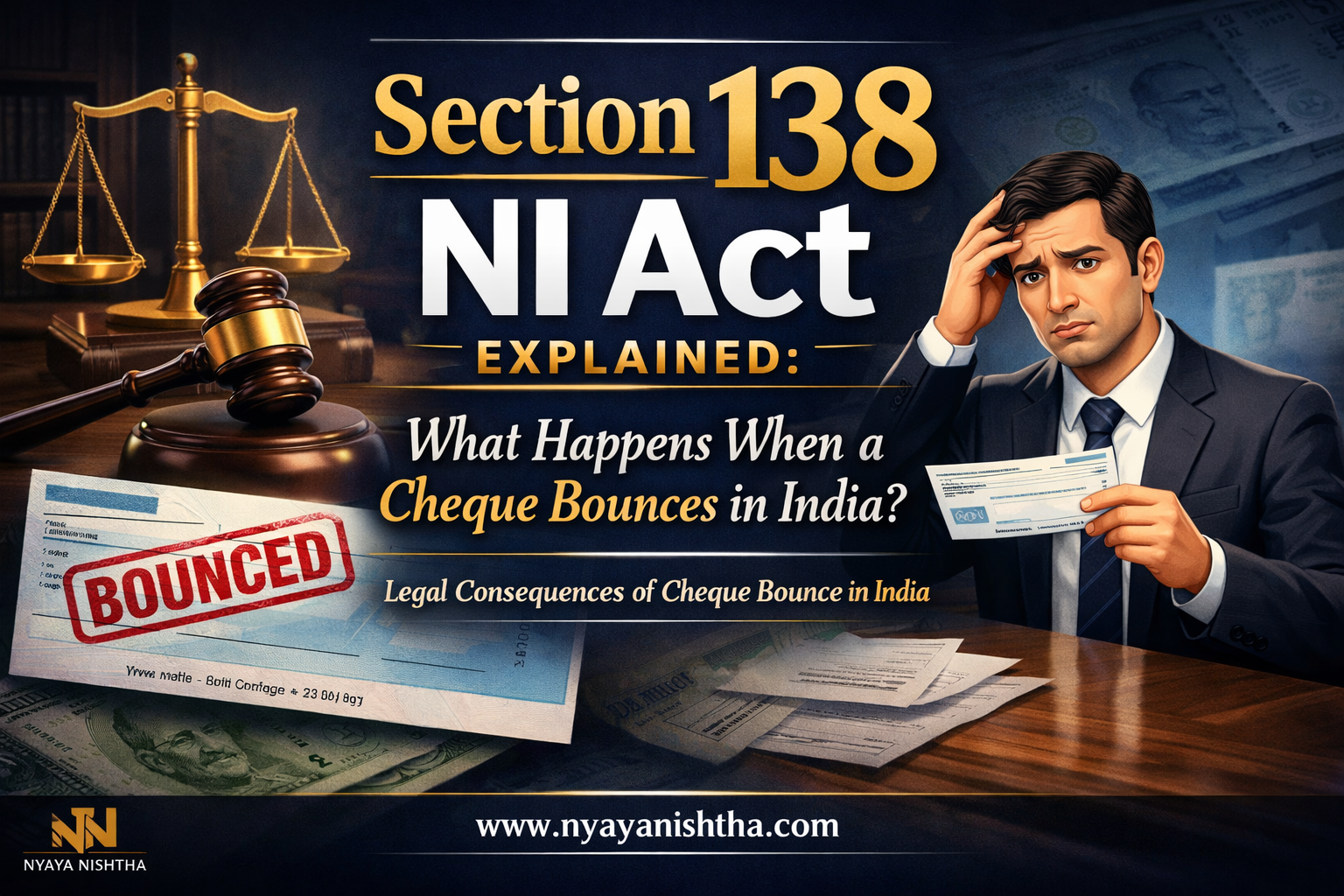
Section 138 NI Act Explained: What Happens When a Cheque Bounces in India?
Legal Explainer All Audiences
Target Keywords: cheque bounce case India, section 138 NI Act, cheque dishonour penalty, what happens if cheque bounces
Meta Description: Cheque bounced? Know your rights under Section 138 NI Act — penalties, process, and how to file a case. Complete guide by www.nyayanishtha.com.
Introduction
A bounced cheque is one of the most common legal disputes in India. Whether you are a businessman who received a dishonoured cheque from a client, or an individual whose post-dated cheque has been returned unpaid — understanding Section 138 of the Negotiable Instruments Act, 1881 is absolutely essential. This law gives you a powerful legal remedy and can result in imprisonment of up to two years for the defaulter. In this article, we break down everything you need to know about cheque bounce cases in India — in plain, simple language.
What is Section 138 of the Negotiable Instruments Act?
Section 138 of the Negotiable Instruments Act, 1881 (NI Act) is the primary law governing cheque dishonour in India. Under this provision, if a person issues a cheque and the cheque is returned unpaid by the bank — due to insufficient funds, account closure, or a stop payment instruction — that person has committed a criminal offence.
The punishment under Section 138 NI Act can be:
▪ Imprisonment of up to 2 years, or
▪ A monetary fine of up to twice the amount of the cheque, or
▪ Both imprisonment and fine.
This makes cheque bounce not just a civil matter of recovery, but a serious criminal offence in India.
When Does Section 138 Apply? — Key Conditions
Not every bounced cheque automatically gives rise to a Section 138 case. The following conditions must be satisfied:
▪ The cheque must have been issued for the discharge of a legally enforceable debt or liability — not as a gift or donation.
▪ The cheque must have been presented to the bank within 3 months of the date written on it.
▪ The bank must have returned the cheque unpaid.
▪ The payee (person who received the cheque) must send a legal notice to the drawer (person who issued the cheque) within 30 days of receiving the bank's dishonour memo.
▪ The drawer must fail to make the payment within 15 days of receiving the legal notice.
Only after all these conditions are met can a criminal complaint be filed under Section 138 NI Act.
Step-by-Step Process: How to File a Cheque Bounce Case
▪ Step 1: Get the Cheque Dishonour Memo from your bank. This is the official document showing the cheque was returned unpaid and the reason for it.
▪ Step 2: Send a Demand Notice (Legal Notice) to the cheque issuer within 30 days of receiving the dishonour memo. This notice must demand payment of the cheque amount and must be sent by registered post or speed post.
▪ Step 3: Wait for 15 days. If the cheque issuer pays the amount within this period, the matter is settled. If not, you can proceed to court.
▪ Step 4: File a Criminal Complaint before the Judicial Magistrate or Metropolitan Magistrate within 30 days of the expiry of the 15-day notice period.
▪ Step 5: The court issues summons to the accused. The trial proceeds and if convicted, the accused faces punishment under Section 138 NI Act.
What is the Time Limit to File a Section 138 Case?
The complaint must be filed within 30 days after the 15-day notice period expires. Missing this deadline can result in the court dismissing your case. It is therefore critical to act quickly and consult a lawyer as soon as your cheque bounces.
Can the Matter Be Settled Out of Court?
Yes — and in fact, most cheque bounce cases in India are settled through negotiation or at Lok Adalat. The accused can pay the cheque amount along with agreed compensation to the complainant, and the case can be compounded (settled) even after it has been filed in court. The Supreme Court of India has consistently encouraged settlement in cheque bounce matters to reduce court pendency.
Frequently Asked Questions (FAQs)
▪ Q: Can I file a Section 138 case if the cheque was given as security? — A: Generally no. Section 138 applies only to cheques issued for a legally enforceable debt or liability. Security cheques can be complex — consult a lawyer.
▪ Q: What if the accused is from another city? — A: The Supreme Court has clarified that the complaint can be filed where the payee's bank branch is located, making it convenient for the complainant.
▪ Q: Is cheque bounce a bailable offence? — A: Yes. Section 138 NI Act is a bailable offence. The accused can get bail.
▪ Q: Can a company be prosecuted under Section 138? — A: Yes. Under Section 141 NI Act, when a company commits a cheque bounce offence, every person who was in charge of the company at the time can also be held liable.
▪ Q: How long does a Section 138 case take? — A: Typically 1-3 years, though this varies by court and circumstances. Many cases settle early through negotiation.
Conclusion
Section 138 NI Act is one of the most powerful and commonly used legal provisions in India for recovering money from a defaulter. If your cheque has bounced, do not delay — the law has strict timelines and missing them can cost you your case. At Nyayanishtha.com, we are committed to making the law accessible and understandable for every Indian citizen.
Need legal help with a cheque bounce matter? Consult a qualified advocate.