
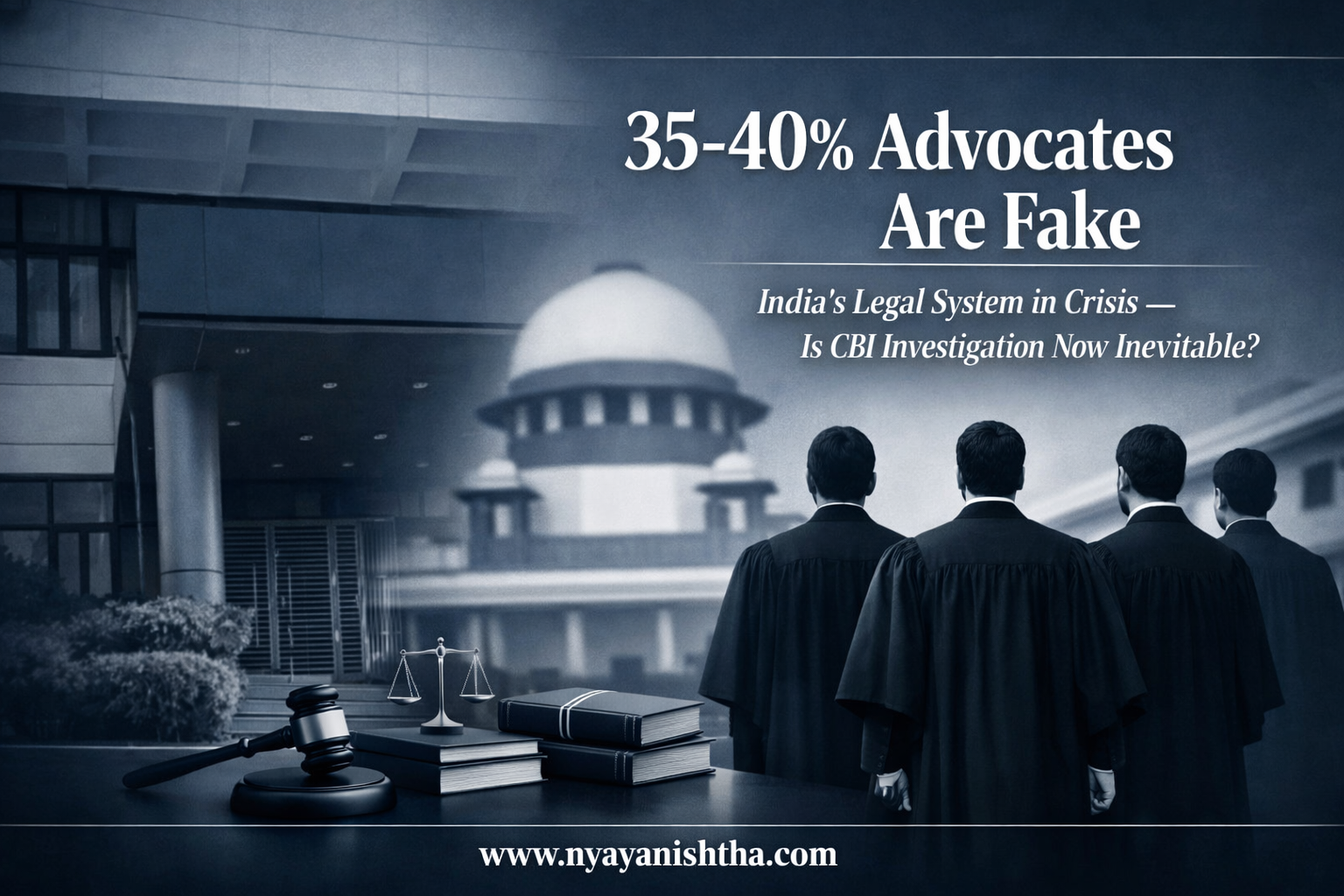
35-40% Advocates Are Fake
India's Legal System in Crisis — Is CBI Investigation Now Inevitable?
Meta Description: BCI Chairperson Manan Kumar Mishra admits 35-40% of India's advocates are fake. With CJI Surya Kant demanding CBI verification and BCI accused of collusion, India's justice system faces its gravest credibility crisis. Focus Keyword: Fake advocates India BCI CBI investigation. Secondary Keywords: Bar Council of India fake lawyers, Manan Kumar Mishra accountability, CJI Surya Kant CBI degree verification, fake law degree India 2026, BCI enrollment fraud
On May 23, 2026, in a revelation that sent shockwaves through India's legal fraternity and beyond, the Chairperson of the Bar Council of India (BCI) — Senior Advocate Manan Kumar Mishra — publicly admitted that an estimated 35 to 40 percent of individuals seen in court complexes wearing black coats and bands are fake advocates operating on the basis of fabricated degree certificates.
This is not a fringe allegation from a whistleblower. This is a confession from the very man entrusted to regulate India's legal profession. And that distinction makes it one of the most alarming institutional admissions in the history of Indian law.
The question every Indian citizen, every genuine advocate, and every litigant must now ask is this: Who allowed this to happen — and for how long?
What Exactly Did the BCI Chairperson Say?
Speaking to news agency IANS, Manan Kumar Mishra stated:
"The Bar Council of India is aware that around 35 to 40 percent of those seen in court complexes wearing black coats and bands are fake. Their degrees are absolutely fake; they manufactured them somewhere or bought them from somewhere, and on that basis, they are practising in courts."
He further disclosed the mechanism by which this scale of fraud was estimated: when the BCI initiated a degree verification process, approximately 40% of advocates simply did not fill up the verification forms. These non-respondents, Mishra said, are suspected to be fake.
Let that figure sink in. Out of an estimated 2 million-plus advocates enrolled across India, somewhere between 700,000 and 800,000 may be fraudulently practising law — advising clients, arguing cases, filing petitions, and potentially influencing the lives and liberty of millions of ordinary Indians who trusted them.
BCI's admission did not emerge in a vacuum. It came as a direct response to sharp observations made by Chief Justice of India (CJI) Surya Kant on May 15, 2026, while hearing a petition filed by Advocate Sanjay Dubey regarding senior advocate designation guidelines.
"I am waiting for some matter… I want the CBI to verify the LLB degrees of most of the Delhi people… in Tis Hazari so and so… the kind of Facebook and things they are putting… do they think we are not watching? BCI will not do anything… Probably CBI will have to do something. BCI will never do, because they are hands in glove, they are absolutely in collusion."
This is the Chief Justice of India publicly stating that the regulatory body responsible for policing India's legal profession is "absolutely in collusion" with those committing fraud. The CJI also expressed that he did not expect the Bar Council of India to act — signaling a complete collapse of institutional trust in the BCI at the highest judicial level.
What makes Manan Kumar Mishra's latest admission even more damning is that it is not even his first.
Back in 2015, speaking at the Lawyers Meet organised by BCI in Chennai, Mishra had already declared that 30% of all lawyers in India hold fraudulent law degrees. That was over a decade ago.
Today, the figure has risen to 35-40%.
This is not merely a failure to solve a problem. This is documented evidence of a problem that has grown worse under the same chairman's watch. The man who has chaired the Bar Council of India continuously since November 9, 2014 — for over a decade — is the same man who acknowledged in 2015 that nearly a third of India's lawyers were fake, and who now admits the situation has deteriorated further.
The accountability question is unavoidable: If the Chairperson knew in 2015, why has the problem worsened by 2026?
Manan Kumar Mishra: A Chairman of a Decade — And the Question of Accountability
Under his chairmanship, the following timeline of failures has unfolded:
• 2015: BCI itself acknowledged ~30% fake advocates nationally.
• 2019-2024: BCI removed only 107 fake advocates from the Delhi roll — a number laughably disproportionate to the scale of the problem in just one city.
• 2024: The Bar Council of Delhi's own Vice Chairman was removed after his LLB degree was found "highly questionable," with BCI itself resolving to seek a CBI probe into the degree's authenticity.
• 2025: BCI directed State Bar Councils to undertake extensive verification — years after the problem was first officially acknowledged.
• 2026: The CJI publicly stated BCI is "in collusion" with fraudulent practitioners.
The Supreme Court has also previously summoned Mishra over alleged violations of the enrollment fee cap under the Advocates Act — a separate but telling indicator of compliance failures at the apex body.
The pattern is not one of a regulator fighting hard against an entrenched problem. It is one of a regulator that has repeatedly acknowledged the problem, issued directives, and then allowed the status quo to continue.
The fake advocate crisis did not emerge overnight. It is the product of multiple systemic failures that have compounded over decades:
India has over 1,500 law schools — many operating without adequate faculty, infrastructure, or academic standards. The proliferation of these institutions, combined with lax BCI inspection regimes, created a fertile ground for the issuance of dubious degrees. There is no preemptive verification mechanism — the system relies entirely on self-submitted documents.
State Bar Councils, which conduct the actual enrollment of advocates, have historically relied on self-submitted documents with minimal cross-verification with issuing universities. There is no real-time electronic integration between universities and bar councils — a gap that fraudsters have systematically exploited for decades.
When BCI launched its degree verification drive, 40% of advocates simply chose not to respond. A credible regulatory body would have treated non-response as grounds for immediate suspension pending verification. Instead, these advocates continued to practice, with no immediate consequence.
The BCI and State Bar Councils are elected bodies, meaning their leadership depends on the votes of enrolled advocates — including, potentially, those with fraudulent credentials. This creates a perverse incentive: a regulatory body may have structural reasons to be lenient with the very people committing fraud.
Lost in the institutional debate are two categories of victims:
Genuine Advocates: Hundreds of thousands of real lawyers — who spent years studying, cleared the All India Bar Examination (AIBE), and built careers on legitimate credentials — are professionally and reputationally harmed by the presence of fraudulent practitioners. Every case mishandled by a fake lawyer damages public trust in the entire profession.
Litigants and Citizens: People who approached courts seeking justice — often in the most vulnerable moments of their lives — may have been represented by individuals with no legal training whatsoever. Imagine a criminal defendant, a victim of domestic violence, a farmer fighting a land dispute: all potentially misrepresented by someone whose only credential is a forged document.
This is not an internal professional matter. This is a constitutional crisis affecting citizens' fundamental right to legal representation.
The question of whether India's genuine legal community will mobilize against this crisis is both urgent and uncertain.
On one hand, the legal fraternity has historically shown enormous capacity for collective action — advocates across India have organized strikes and boycotts over far lesser issues. The fake advocate crisis strikes at the heart of professional dignity and legitimate livelihoods.
On the other hand, bar council politics are deeply entrenched, and the very bodies meant to organize and protect advocates are the ones implicated in allowing the fraud. Any movement to demand accountability from BCI leadership would have to contend with the institutional machinery of those same leaders.
The CJI's own words — expressing doubt that BCI will act — should serve as a catalyst for advocates to demand more than press releases and promises from their regulatory leadership.
Based on the evidence available, a strong case exists for CBI involvement — and the country's highest judicial authority has already signaled the same.
CJI Surya Kant explicitly stated he was contemplating ordering a CBI investigation into the genuineness of law degrees, particularly in Delhi. Legal analysts have noted that a CBI probe becomes not just appropriate but potentially mandatory when the following conditions are met:
• Coordinated fraud spanning multiple states and universities — already evidenced by BCI's own admissions.
• Regulatory body failure or complicity — explicitly alleged by the CJI himself.
• Fabrication of official academic documents — a criminal offense under the Indian Penal Code.
• Obstruction during internal investigations — evidenced in the Bar Council of Delhi Vice Chairman's case, where university officials were found to be uncooperative and obstructive.
Each of these conditions already appears to be satisfied.
The BCI's removal of only 107 fake advocates from Delhi over a five-year period — against a backdrop where 35-40% of the profession may be fraudulent — is not investigation. It is theater. The scale of the problem, the cross-state nature of degree fraud, the involvement of university officials, and the explicit failure of the statutory regulator make this precisely the kind of systemic criminal conspiracy that the CBI was designed to investigate.
For those arguing that professional verification should remain within the domain of the BCI, the answer must now be: that ship has sailed. The BCI has had a decade-plus to address this crisis. The numbers have gotten worse, not better.
The crisis demands action on multiple simultaneous fronts:
• Supreme Court should direct a time-bound CBI investigation into law degree fraud across major states.
• All advocates who failed to submit verification forms should face immediate suspension from practice pending verification.
• Real-time digital integration between universities, BCI, and State Bar Councils must be mandated.
• The dual role of BCI Chairman as an elected MP creates conflicts of interest that must be legally addressed.
• An independent judicial oversight committee should monitor BCI compliance with degree verification.
• Enrollment processes must be overhauled to include mandatory direct university verification before bar enrollment.
• Individuals found practising on fake degrees must face prosecution under forgery and cheating provisions.
• University officials who issued or facilitated fake degrees must be prosecuted.
• Bar council officials who knowingly enrolled or failed to act against fake advocates must face legal accountability.
Published: May 23, 2026 | Category: Legal Affairs, India
Tags: Bar Council of India, Fake Advocates, Manan Kumar Mishra, CJI Surya Kant, CBI Investigation, Law Degree Fraud, Legal Reform India, BCI Accountability
Sources: Live Law, The Federal, India Legal Live, Law Street Journal, IANS