Supreme Court Refers UAPA Bail Jurisprudence to Larger Bench: A Landmark Moment for Personal Liberty in India
Supreme Court Refers UAPA Bail Jurisprudence to Larger Bench: A Landmark Moment for Personal Liberty in India
Category: Supreme Court · Criminal Law · UAPA | Published: May 29, 2026
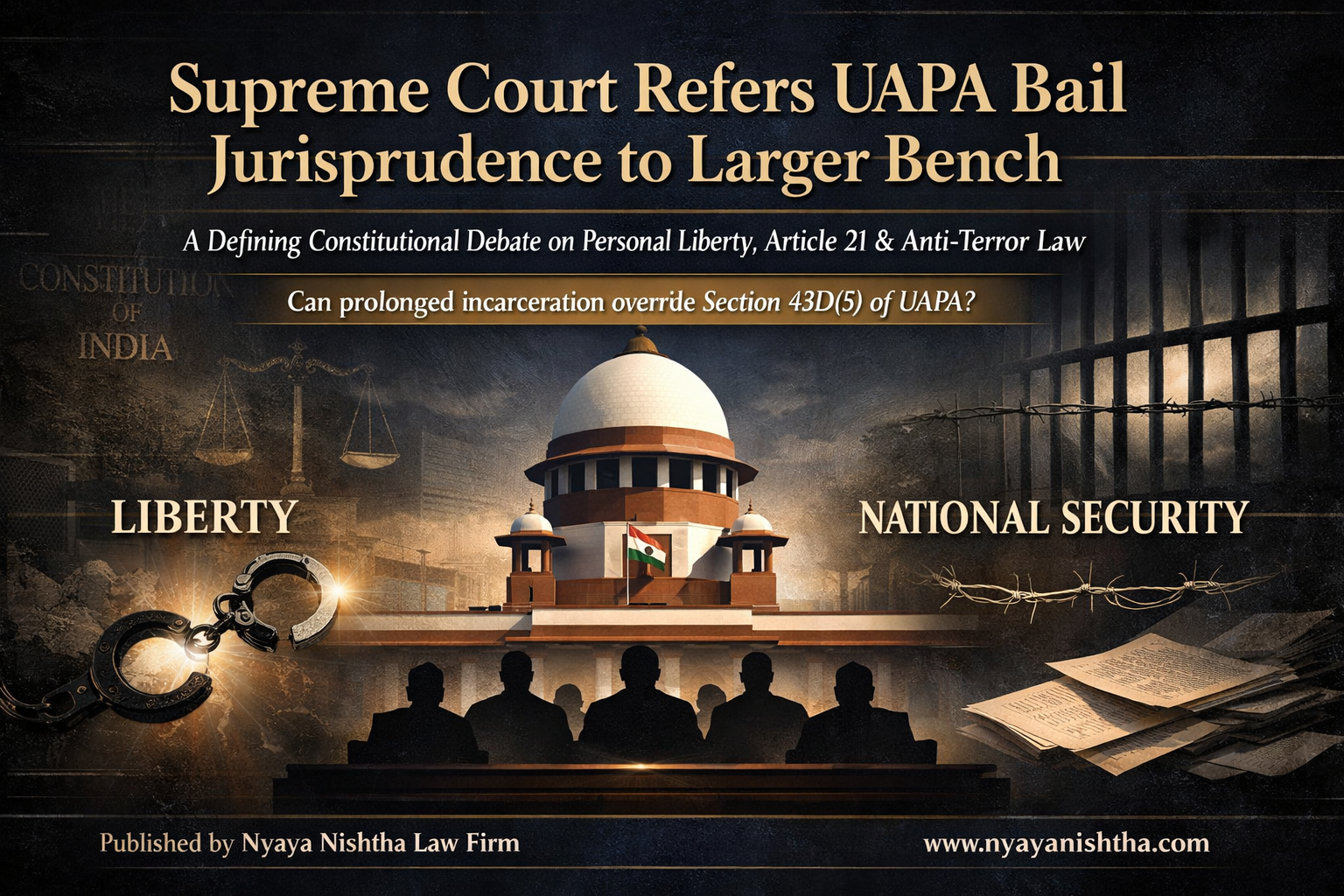
In a constitutionally significant move, the Supreme Court of India has referred the question of bail under the Unlawful Activities (Prevention) Act to a larger bench — directly confronting the tension between national security law and Article 21’s guarantee of personal liberty.
Background: Why UAPA Bail Has Always Been Controversial
India’s Unlawful Activities (Prevention) Act, 1967 (UAPA) is the country’s primary anti-terror legislation. While it grants sweeping investigative powers to agencies like the National Investigation Agency (NIA), its bail provisions have long been the subject of intense legal debate.
Unlike ordinary criminal cases — where the default is liberty pending trial — UAPA creates an environment where the accused must clear an extraordinarily high bar to secure bail. Critics argue this effectively treats an accused as guilty until proven innocent, particularly when trials are delayed by years.
Key Facts About UAPA Bail:
• UAPA was originally enacted in 1967 to deal with unlawful organisations, and later expanded to cover terrorism and terrorist financing.
• Section 43D(5) prohibits a court from granting bail if it is of the opinion, on a perusal of the case diary, that the accusation appears to be prima facie true.
• This standard is far more stringent than the standard under the CrPC or BNSS, where bail is largely a matter of judicial discretion.
• Thousands of undertrials across India are currently imprisoned under UAPA — many for periods exceeding 5 years without a final verdict.
What Happened: The Supreme Court’s Referral in May 2026
In a development that legal experts are calling one of the most constitutionally significant judicial moves of 2026, a bench of the Supreme Court of India formally referred the question of bail jurisprudence under UAPA to a larger constitutional bench.
The core legal question referred is: Can the constitutional courts — in exercise of their powers under Articles 32 and 226 — grant bail to an undertrial accused under UAPA if there is prolonged incarceration and unreasonable delay in trial, even when the conditions in Section 43D(5) are not met?
In the same proceedings, the Court granted interim bail to two accused individuals from the 2020 Delhi riots case, signalling that the bench was deeply troubled by their continued incarceration without trial.
“The right to liberty is not a gift of the State — it is an inherent right. When the State invokes anti-terror law, it must do so with greater constitutional caution, not less.”
Understanding Section 43D(5) of UAPA: India’s Most Contentious Bail Clause
Section 43D(5) of the UAPA reads as follows in effect: if the Public Prosecutor opposes bail, a court shall not release the accused on bail if on a perusal of the case diary or the report made under Section 173 of the Code, it is of the opinion that there are reasonable grounds to believe that the accusation against such person is prima facie true.
This creates a reverse-onus situation: rather than the prosecution proving guilt, the accused must demonstrate that the accusations cannot even prima facie be taken as true. Courts have repeatedly held that this is an extraordinarily high burden for any accused to discharge.
How Courts Have Interpreted Section 43D(5) So Far
Over the years, various High Courts and the Supreme Court have taken differing views on how strictly Section 43D(5) must be applied. While some judgments have strictly adhered to the literal text, others have tried to carve out exceptions — especially in cases where:
• The accused has spent several years in custody without trial commencing;
• There is no reasonable prospect of the trial concluding in the near future;
• The health of the accused is severely compromised by continued detention.
The K.A. Najeeb Precedent: A Constitutional Lifeline
The most important judicial anchor in this debate is the Supreme Court’s 2021 ruling in Union of India v. K.A. Najeeb. In that landmark decision, a three-judge bench held that:
“The statutory restrictions under UAPA would not limit the constitutional power of courts to grant bail on account of violation of the right to speedy trial under Article 21.”
In essence, K.A. Najeeb established that where trial is inordinately delayed and the accused’s Article 21 rights are being violated, a constitutional court retains the power to grant bail — regardless of the bar in Section 43D(5).
However, the challenge is that lower courts and even different High Court benches have applied this precedent inconsistently. The Supreme Court’s 2026 referral to a larger bench aims to settle this inconsistency with a definitive, binding constitutional pronouncement.
The Umar Khalid Case: The Catalyst for Referral
The immediate trigger for the larger bench referral was the bail proceedings of Umar Khalid, a former JNU scholar who has been in custody since September 2020 — over five years — in connection with the alleged conspiracy behind the 2020 Delhi riots, which left 53 people dead and over 700 injured.
Khalid was booked under the UAPA and several provisions of the Indian Penal Code. Both the Trial Court and the Delhi High Court denied him bail, with the latter observing that the accusations against him appeared prima facie true and that his actions qualified as a “terrorist act” under UAPA.
When the matter reached the Supreme Court, the bench observed — critically — that the lower court had failed to follow the binding precedent in K.A. Najeeb while rejecting the bail application. The Court’s disapproval of this oversight was palpable, and the referral to a larger bench followed.
Timeline: Umar Khalid’s Bail Journey
• September 2020: Umar Khalid arrested by Delhi Police under UAPA.
• October 2022: Delhi High Court rejects bail, says accusations prima facie true.
• April 2023: Bail plea filed before Supreme Court; adjourned 13+ times.
• May 2026: Supreme Court grants interim bail and refers larger UAPA bail question to a larger bench.
Legal Implications of the Larger Bench Referral
The Supreme Court’s decision to refer this matter has far-reaching consequences for India’s criminal justice and anti-terror jurisprudence.
1. Establishing a Uniform Standard Across Courts
Currently, High Courts across India apply varying standards when considering bail under UAPA. A five-judge or larger bench ruling would bind all High Courts and subordinate courts uniformly, eliminating the “lottery” aspect of UAPA bail.
2. Defining the Boundaries of Section 43D(5)
The larger bench could clarify whether Section 43D(5) is absolute or whether it must yield to constitutional mandates when a person’s liberty is being violated through indefinite incarceration.
3. Strengthening the Right to Speedy Trial
India’s UAPA cases often stretch for a decade without completion. A definitive ruling could compel trial courts to expedite proceedings or risk being ordered to grant bail as a constitutional remedy.
4. Impact on Current Undertrials
Thousands of UAPA undertrials currently in detention — many not yet tried — could potentially benefit if the larger bench lays down progressive bail norms that give greater weight to prolonged detention.
Article 21 vs. Anti-Terror Law: India’s Central Constitutional Conflict
At the heart of this entire debate lies a fundamental constitutional question: Can Parliament enact a law that effectively removes the safeguard of personal liberty for an indefinite period before a person is even tried and convicted?
Article 21 of the Indian Constitution guarantees that no person shall be deprived of their life or personal liberty except according to procedure established by law. The Supreme Court — through decades of jurisprudence including Maneka Gandhi v. Union of India (1978) — has held that this procedure must be fair, just, and reasonable.
Defenders of strict UAPA bail conditions argue that terror-related offences pose a unique threat to national security and that the state’s interest in preventing such crimes justifies stringent pre-trial detention. Opponents counter that a legal system that imprisons a person for years without trial — and prevents them from obtaining bail through ordinary means — is fundamentally incompatible with a constitutional democracy.
“India cannot be a nation where bail is the exception and jail is the rule — whether under ordinary criminal law or anti-terror statutes.”
The larger bench will likely grapple with whether UAPA’s Section 43D(5), as applied in practice, passes the constitutional test of proportionality — i.e., whether the restriction on liberty is proportionate to the object sought to be achieved.
Frequently Asked Questions
Q1. What is Section 43D(5) of UAPA and why is it controversial?
Section 43D(5) restricts courts from granting bail under UAPA if the Public Prosecutor opposes it and the court finds the accusation to be prima facie true based on case records. It is controversial because it sets an almost impossible standard for accused persons to meet, effectively enabling indefinite pre-trial detention.
Q2. What did the Supreme Court decide in K.A. Najeeb?
In K.A. Najeeb (2021), the Supreme Court held that constitutional courts can grant bail under UAPA in cases of prolonged incarceration and unreasonable trial delay, even if the conditions of Section 43D(5) are not otherwise met, as Article 21’s guarantee of speedy trial overrides the statutory restriction.
Q3. Why has the Supreme Court referred UAPA bail to a larger bench in 2026?
The Court referred the matter because different benches and High Courts have been applying UAPA bail precedents inconsistently. A larger bench ruling will settle the law definitively and create binding precedent on when a constitutional court can override Section 43D(5) restrictions.
Q4. What is Article 21 of the Indian Constitution?
Article 21 guarantees that no person shall be deprived of life or personal liberty except according to procedure established by law. The Supreme Court has held that this procedure must be fair, just, and reasonable — and includes the right to a speedy trial.
Q5. How long has Umar Khalid been in custody?
As of May 2026, Umar Khalid has been in custody for over five years since his arrest in September 2020, without the trial being completed — one of the key factors that prompted the Supreme Court to intervene and refer the bail question to a larger bench.
Q6. How many people are imprisoned under UAPA in India?
Government data and civil society reports indicate that thousands of individuals are currently imprisoned as undertrials under UAPA across India, many without their cases reaching trial stage even after several years of incarceration.
Conclusion: A Constitutional Moment India Cannot Afford to Miss
The Supreme Court’s decision to refer UAPA bail jurisprudence to a larger bench is one of the most significant constitutional developments in Indian criminal law in recent years. It is not merely about individual cases — it is about what kind of legal republic India chooses to be.
If the larger bench affirms that Article 21 cannot be suspended indefinitely through the mechanism of anti-terror bail restrictions, it will reshape how thousands of UAPA cases are handled across the country. If it upholds strict Section 43D(5) standards without exception, it will have the opposite effect.
Either way, the ruling is awaited — and will be defining. India’s constitutional commitment to personal liberty, the right to a fair trial, and the rule of law all hang in the balance.
Tags: UAPA · Supreme Court 2026 · Article 21 · Bail Jurisprudence · K.A. Najeeb · Umar Khalid · Personal Liberty · Anti-Terror Law India · Section 43D · Delhi Riots 2020 · Criminal Law India · CJI Surya Kant