
Published on: May 20, 2026 Category: Current Legal News | Youth & Law | Constitutional Affairs Target Keywords: Cockroach Janta Party, CJP India, CJI Surya Kant cockroach remark, Abhijeet Dipke, youth movement India 2026, viral political party India Meta Description: What is the Cockroach Janta Party? Who founded it, why did it go viral, what is its manifesto, and what did CJI Surya Kant actually say? Complete guide by www.nyayanishtha.com
On May 15, 2026, Chief Justice of India Surya Kant said one word from the Supreme Court bench that he probably did not expect would echo across every corner of India's internet within 48 hours — "cockroach."
Within two days of that remark, India had a new satirical political party, a five-point manifesto, a slogan ("Main Bhi Cockroach"), a party anthem, a website, and over 1,00,000 registered members. By the end of the week, the number crossed 3,50,000. Two sitting Members of Parliament had publicly joined. The movement had trended nationally on X (formerly Twitter) and Instagram. A cleanliness drive was held on the banks of the Yamuna by volunteers dressed in cockroach costumes.
What began as a single tweet had become India's most talked-about political experiment of 2026.
This is the complete story of the Cockroach Janta Party (CJP) — who founded it, why it went viral, what it stands for, who supports it, and what it reveals about the frustrations of India's youth.
On May 15, 2026, the Supreme Court of India was hearing a case related to fake professional credentials — people allegedly obtaining law and medical degrees fraudulently and entering professions they were not qualified for.
During the hearing, Chief Justice of India Surya Kant made oral observations that immediately went viral. He said:
"There are already parasites of society who attack the system and you want to join hands with them? There are youngsters like cockroaches, who don't get any employment, they don't have any place in profession. Some of them become media, some of them become social media, some of them become RTI activists, some of them become other activists, and they start attacking everyone."
The remark spread across social media platforms within hours. The CJI later clarified that his oral observations were directed specifically at people who use fake degrees to fraudulently enter professions such as law and media — and not at unemployed youth in general. However, by the time the clarification came, the internet had already moved — and moved fast.
The youth of India heard the words "youngsters like cockroaches" and responded not with silence, but with satire.
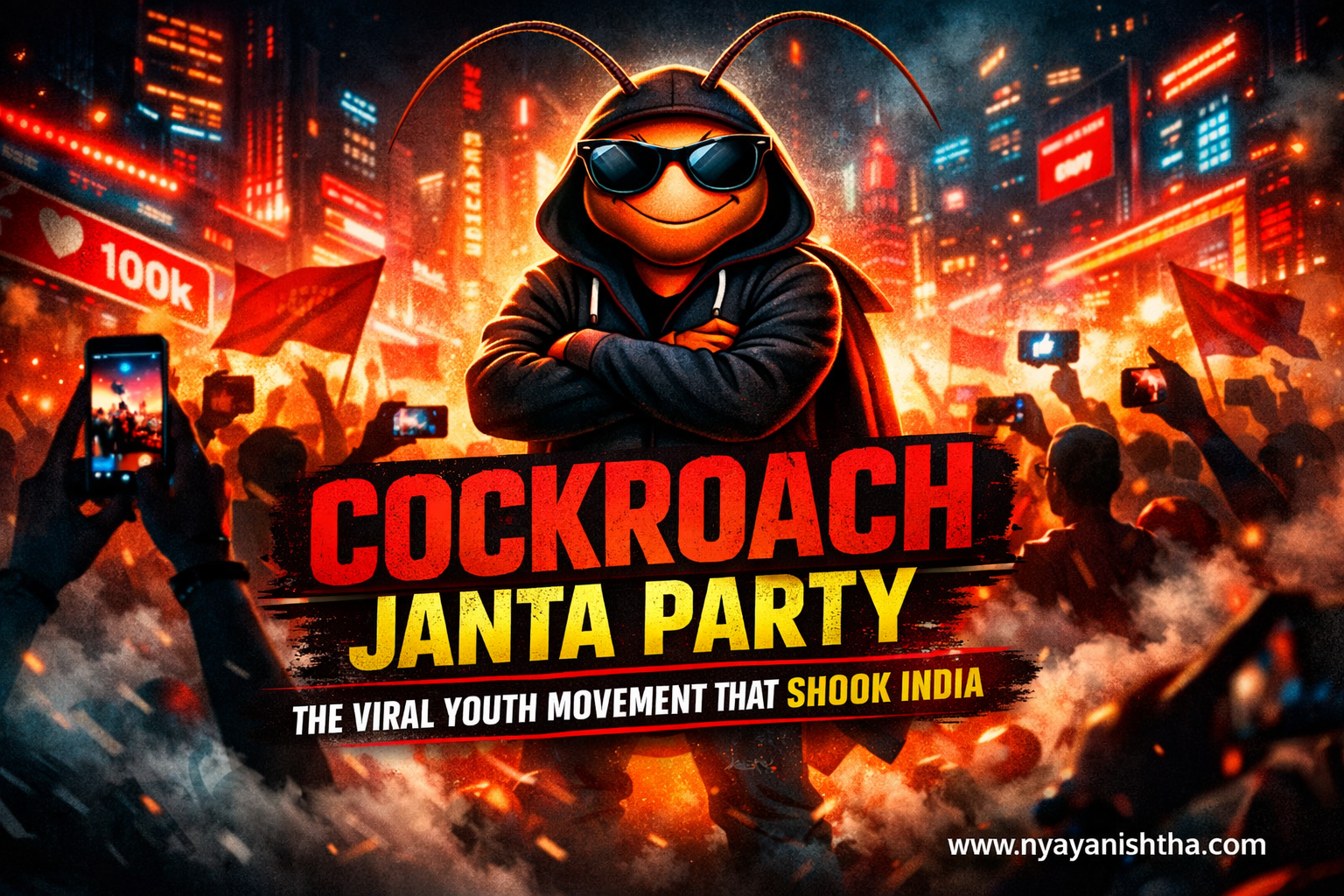
The Cockroach Janta Party (CJP), officially styled as the "Cockroach People's Party," is an Indian satirical political movement founded on May 16, 2026 — exactly one day after the CJI's remarks went viral.
It was founded by Abhijeet Dipke, a 30-year-old digital media strategist and political communication expert from Aurangabad, Maharashtra. Dipke is a former social media strategist and volunteer for the Aam Aadmi Party (AAP) between 2020 and 2023, and is currently pursuing a Master's degree at Boston University, USA.
His founding post on X (Twitter) was deliberately casual: "Launching a new platform for all the 'cockroaches' out there."
He did not expect what happened next.
Within 48 hours, the CJP had:
Dipke himself was surprised. He said: "The Cockroach Janta Party was supposed to be a joke. But I had not expected it would draw such an encouraging response. I think the biggest takeaway is that young people in India are frustrated — no political party has done anything for them in the last few years. That is precisely why all have signed up as cockroaches."
Despite its deliberately playful and satirical identity, the CJP released a formal five-point manifesto that mixes absurdist humour with pointed political demands. The party describes itself as:
"A political front of the youth, by the youth, for the youth — Secular, Socialist, Democratic, and Lazy."
Its headquarters are listed as "wherever the WiFi works."
The Five-Point Manifesto of the Cockroach Janta Party:
Additional demands have included eliminating CBSE rechecking fees, voicing support for students affected by the NEET controversy, and calling out exam paper leaks that have robbed thousands of students of fair opportunities.
The party's membership criteria are listed as being "unemployed, lazy, chronically online" and possessing the "ability to rant professionally." Its motto is: Unity. Resilience. Progress.
Its website describes the party as: "A political party for the people the system forgot to count. Five demands. Zero sponsors. One large, stubborn swarm."
Abhijeet Dipke, the Founding President of the Cockroach Janta Party, is not a career politician. He is a 30-year-old digital media and political communication professional from Aurangabad (now Chhatrapati Sambhajinagar), Maharashtra.
His background:
His first post about the CJP — a casual tweet inviting "cockroaches" to join — was not intended as a serious political project. But the response from India's youth was immediate and overwhelming. Within hours, people flooded his DMs demanding he "put his money where his mouth is." He did — within 48 hours, the entire CJP infrastructure was live.
The CJP's growth on social media has been extraordinary — even by viral internet standards:
The hashtag #CockroachJantaParty and #MainBhiCockroach trended on X for multiple consecutive days. Memes, reels, parody posts, and serious political commentary flooded every major platform simultaneously.
The CJP also announced plans for a virtual Gen-Z convention — an entirely online political gathering that underscores the movement's digital-first identity.
The CJP has drawn an unusually diverse range of supporters:
1. India's Unemployed and Frustrated Youth The core constituency. Young Indians dealing with unemployment, competitive exam failures, NEET controversies, exam paper leaks, and the feeling that no mainstream political party genuinely represents their interests.
2. Gen-Z Social Media Users Chronically online young Indians who use humour and satire as tools of political expression. The CJP's irreverent tone, meme-friendly content, and deliberately absurdist brand identity resonates deeply with this demographic.
3. RTI Activists and Citizen Journalists The CJI's remarks specifically mentioned RTI activists. Many such activists felt directly targeted and found the CJP's reclaiming of the "cockroach" label empowering.
4. Opposition Politicians
5. Media Advocacy Organisations Maadhyam, a media organisation that campaigns for parliamentary reform, expressed support for the CJP's media-related demands.
6. Supreme Court Lawyers Several lawyers and legal commentators also reacted to the CJI's remarks — some critically, questioning whether a sitting Chief Justice should use such language about citizens.
What is striking about the CJP is that it has not remained confined to the internet. Within days of the party's launch, its supporters took to the streets — literally.
A group of youth volunteers carried out a cleanliness drive along the Yamuna river in Delhi, dressed in cockroach costumes and carrying placards. Their message was deliberate: if the Chief Justice called them cockroaches, they would respond by doing what cockroaches do best — surviving, adapting, and cleaning up the mess left by others.
The offline mobilisation — however symbolic — signals that the CJP has tapped into a real and deep vein of youth frustration that extends beyond social media scrolling.
Additionally, the party is considering fielding a candidate in the Bankipur Assembly by-election in Bihar — a direct contest against major parties including the BJP and Prashant Kishor's Jan Suraaj Party. Political observers note this as an attempt to translate online momentum into electoral politics.
Strip away the cockroach costumes, the memes, and the satirical manifesto, and the CJP is pointing at something very real.
India's youth unemployment rate remains a serious concern. Competitive examination scandals — NEET paper leaks being the most prominent — have shattered the trust of millions of students who spent years preparing. The entry-level job market remains highly competitive. Many young Indians with degrees feel locked out of meaningful professional opportunities.
When India's Chief Justice — the head of the institution meant to uphold justice for all — reached for the word "cockroach" to describe these young people, it struck a nerve precisely because it felt, to many, like institutional dismissal of their genuine struggles.
The CJP's rapid rise is therefore less about cockroaches, and more about a generation demanding to be taken seriously.
As Dipke himself put it: "The current politics of India has very little to offer Gen-Z beyond distractions, division, and empty promises. Why wouldn't Gen-Z be frustrated?"
From a legal standpoint, the CJP raises a few interesting questions worth examining:
Freedom of Speech and Satire: Political satire is fully protected under Article 19(1)(a) of the Constitution of India. The CJP, as a satirical movement, is entirely within its constitutional rights to exist, organise, and express political opinions.
Judicial Propriety: While judges enjoy the freedom to make oral observations during hearings, the Bar Council of India and several senior advocates have noted that public figures — including judges — must be mindful of language that could be perceived as dismissive of large sections of the population.
RTI Activism: The CJI's remarks specifically mentioned RTI activists. The Right to Information Act, 2005 is a fundamental transparency mechanism that the Supreme Court itself has upheld repeatedly. RTI activists play a constitutionally recognised role in democratic accountability.
Electoral Participation: If the CJP registers formally with the Election Commission of India and contests elections, it would be exercising rights under Article 326 and the Representation of the People Act, 1951 — fundamental democratic rights available to every citizen.
Q: Is the Cockroach Janta Party a real registered political party? A: No. As of May 2026, the CJP is a satirical political movement and has not been formally registered with the Election Commission of India. However, it is considering contesting the Bankipur Assembly by-election.
Q: How can I join the Cockroach Janta Party? A: The CJP accepts members through a Google Form on its official website. Membership is open to anyone who considers themselves "unemployed, lazy, chronically online" and capable of "ranting professionally."
Q: Did CJI Surya Kant apologise for the remark? A: CJI Surya Kant clarified that his remarks were directed at people using fake degrees to fraudulently enter professions — not at unemployed youth generally. A formal public apology has not been reported.
Q: What is the CJP's election symbol? A: A mobile phone — representing the digital-first, smartphone generation that forms its core constituency.
Q: Is the CJP affiliated with any existing political party? A: No. The CJP explicitly describes itself as independent with "zero sponsors." Though individual opposition MPs have expressed support, no formal political affiliation has been announced.
Q: Where is the CJP's headquarters? A: Officially, "wherever the WiFi works."
History is full of moments when an insult was reclaimed as an identity. When the powerful call the powerless names, the powerless sometimes wear those names as armour.
In just five days, the Cockroach Janta Party went from a single tweet to a national conversation about youth unemployment, judicial accountability, media freedom, electoral reform, and the right of every Indian — employed or not, online or offline — to be treated with dignity by the institutions that serve them.
Whether the CJP ultimately contests elections, registers formally, or remains a satirical digital movement, its impact has already been felt. It has forced a conversation that needed to happen. And in a democracy, that is precisely what citizens — cockroaches or not — have every right to do.
Have a legal question about political rights, RTI activism, or constitutional freedoms? Consult a qualified advocate.
Tags: Cockroach Janta Party | CJI Surya Kant | Abhijeet Dipke | Youth Movement India | Viral Politics 2026 | RTI Activism | Supreme Court India | Mahua Moitra | Gen-Z India | Indian Political Satire